Online Demand is Reshaping Portugal's Campervan Market
The ride away market for Portugal 2026–2027: what does the data say?

There’s a song, from the 80’s, by Willie Nelson, called “On the Road Again” and, somewhere in the middle, it goes: “On the road again / Goin' places that I've never been / Seein’ things that I may never see again /And I can't wait to get on the road again…”
(You might want to check it, it’s a nice sound! But let’s get back to business)
The song is perfectly aligned with the topic at hand: Portugal's booming campervan rental online market.
Lately, “van life” is way more than a hashtag or a trend that looks good on social media.
Now, tourism in general is going through a massive shift. And, as for Portugal, there is this kind of traveller who, upon landing at Porto, Lisbon or Faro airport, has absolutely no interest in checking into a hotel. They want keys, a steering wheel, and an open road.
And they came prepared. They have already researched the best wild camping spots along the Vicentina coast, mapped their route through the Alentejo, bookmarked three clifftop sunsets on the Algarve that they intend to wake up next to, as well as the next stop. They have a full trip planned through the country, from north to south, going to the interior and getting to know even the not so “touristy” sites.
This means they came with a full preparation pack. They booked their trip six weeks ago (or more!), from home (wherever that is), in English, possibly on their phone, after spending approximately 45 minutes comparing five different operators.
So, any campervan companies out there: these people are your customers. And there are more and more of them every year.
Because (go figure!) Portugal has become one of Europe's premier campervan destinations. And we’re not talking just about sun-seekers coming after a cheap beach holiday, but a particular breed of independent traveller who values freedom, flexibility, and the kind of experience that cannot be replicated by a resort pool.
Camping and motorhome parks are now the fastest-growing accommodation category across the entire European Union, and Portugal is riding that wave with considerable force.
Tourism receipts hit a record €27.7 billion in 2024, up 8.8% on the year before. And here’s what brought us here: the numbers don’t lie. While the campervan rental segment is still in a phase of consolidation, it has yet to fully catch up to the scale of that opportunity.
That gap is either a problem or an opening, depending on who you are… and how you're choosing to evaluate the opportunity.
Search demand: the growth story isn’t exactly hiding
The rise in online search demand for campervan rental in Portugal has grown steadily over the past few years.
More importantly, this isn’t a temporary tourism boom or a post-pandemic trend. The category was already gaining momentum long before COVID entered the picture. The pandemic simply accelerated a trend that was already moving upwards.
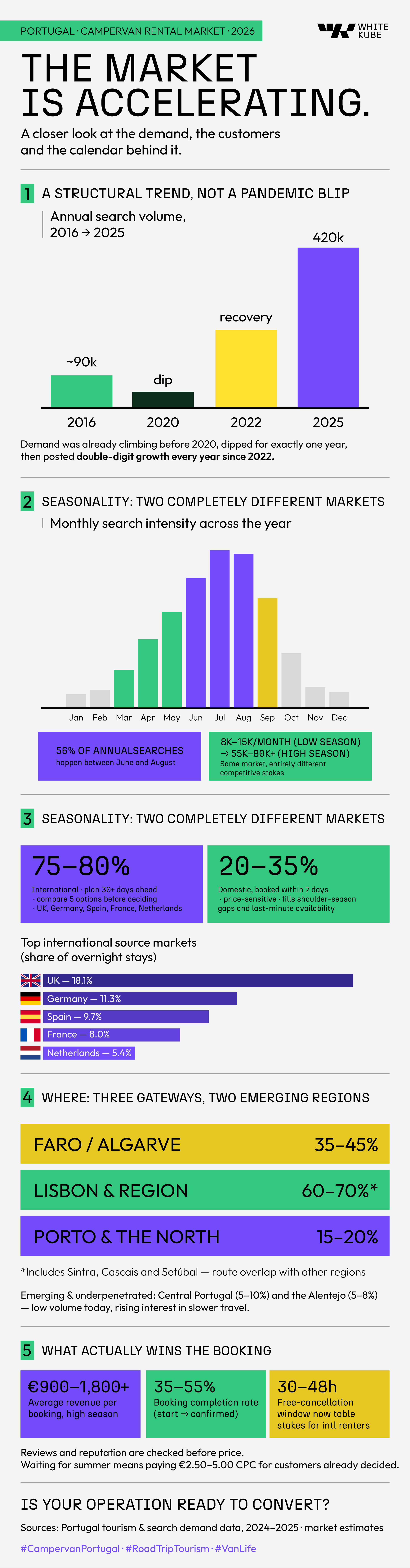
Annual search volumes have risen from approximately 90,000 searches in 2016 to an estimated 380,000 to 420,000 high-intent searches in 2025. We’re talking about a near fourfold increase. 2020 registered a predictable pandemic-related dip, but the market fully recovered by 2022 and has since recorded strong double-digit growth year after year.
The growth curve is consistent and structural, meaning that this is a category that was expanding before the pandemic and accelerated sharply after it.
It is important to look at the commercial meaning of this demand. Because this is where things get interesting.
These are not casual browsers looking at travel inspiration, and these searches are not driven by daydreaming travellers scrolling through holiday ideas on a rainy day. We’re talking about high-intent search queries such as "campervan rental Algarve," "motorhome hire Faro," "rent campervan Portugal”, which signal a clear purchase intent with a high conversion potential. In practical terms, these users are already halfway to booking. They know what they want, and they’re just deciding who they will close business with.
That creates an obvious challenge for rental companies. As demand grows, so does competition for visibility. Every operator is chasing the same pool of highly motivated customers, and nowhere is that battle fiercer than during Portugal’s peak tourism season, concentrated between June and September, which compresses that competition into a narrow window that punishes operators who are unprepared. Those often discover that the market has little patience for poor visibility, slow websites, or weak booking systems.
Monthly search volume in the low season ranges between 8,000 and 15,000 queries. In the high season, that number climbs to 55,000 to over 80,000 searches per month. This seasonality shows how the market stands: we’re talking about an entirely different market (the peak season one), with higher stakes, different costs, fiercer competition, more demanding customers, and a significantly greater revenue potential for businesses positioned to capture it.
International vs domestic market: two very different strategies
There’s a structural split in demand, which happens to be the most important thing to understand about this market, where the most common strategic errors are made.
While Portuguese families are enthusiastic campers (they dominate overall overnight campsite stays nationally, particularly in August), the campervan rental market tells a different story. An estimated 75 to 80% of rental bookings come from international tourists. The UK leads inbound overnight stays in Portugal at 18.1%, followed by Germany at 11.3%, Spain at 9,7%, France at 8%, and the Netherlands at 5.4%. And don’t be fooled, these are not the countries with the deepest-rooted campervan culture in Europe. They just happen to have chosen Portugal to do it this year.
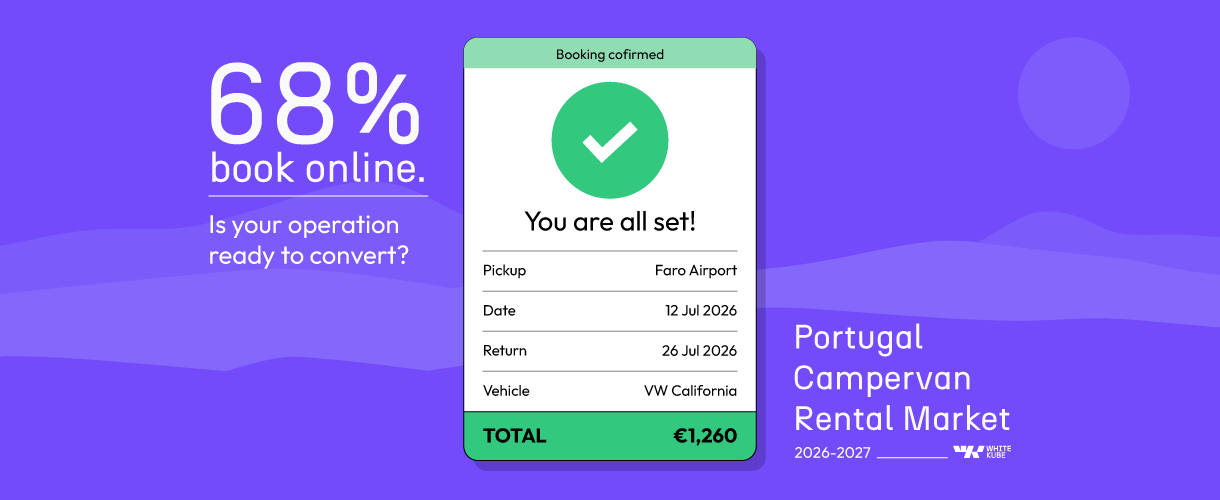
This international dominance has direct implications for consumer behaviour. International renters plan well ahead. An estimated 70 to 85% of international bookings are made more than 30 days before travel. They are methodical, comparison-driven, and often deeply committed to their decision before they ever arrive at your booking page.
The average revenue per high-season booking runs from €900 to well over €1,800, driven by daily rate, rental duration, and add-ons. That is not a customer you win at the last minute, and it is not a customer who books because you dropped the price on “last call promo Thursday campaign”.
When it comes to the domestic market, it behaves completely differently. Portuguese renters are more spontaneous, more price-sensitive, and more likely to book at short notice. In fact, between 20% and 35% of domestic bookings are made within seven days of travel.
However, that makes domestic demand strategically important, as it serves as a powerful tool for filling fleet gaps during shoulder seasons, boosting occupancy during quieter periods, and converting remaining availability in peak weeks. A well-timed offer can turn unused availability into revenue remarkably quickly.
The error is not having a domestic strategy, but applying the same acquisition strategy to both audiences. International demand requires early, planned, brand-building campaigns. Domestic demand responds to tactical promotions and last-minute urgency.
The smartest operators recognise this divide and build their pricing, availability, and marketing frameworks accordingly. Different audiences have different buying behaviours, and the businesses that acknowledge that reality are invariably the ones that maximise occupancy, protect margins, and extract the greatest value from their fleet throughout the year.
Search seasonality: revenue is won before peak season
The Portuguese campervan market is highly seasonal. Meaning that search seasonality in the Portuguese campervan market is almost like a roller coaster.
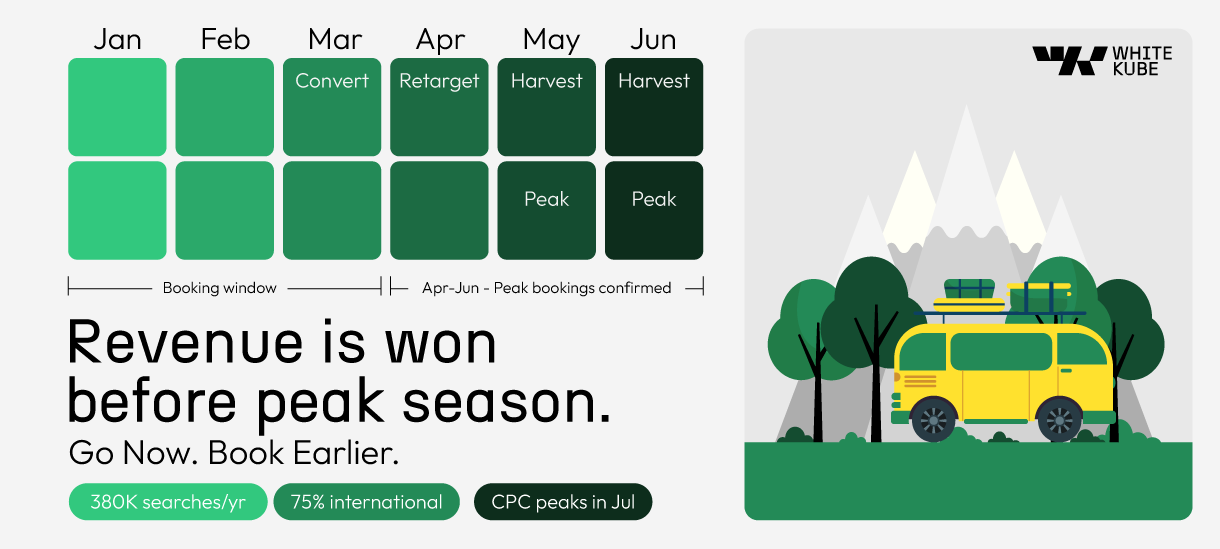
Demand accelerates from April onwards, surges through June, peaks in July and August, then falls sharply from October onwards. More than half of all annual searches happen between June and August, registering roughly 56% of annual search volume, while January and February combined barely register at around 4%.
The key point is that peak-season revenue is usually secured well before peak season arrives. Revenue is primarily booked in spring, not in summer.
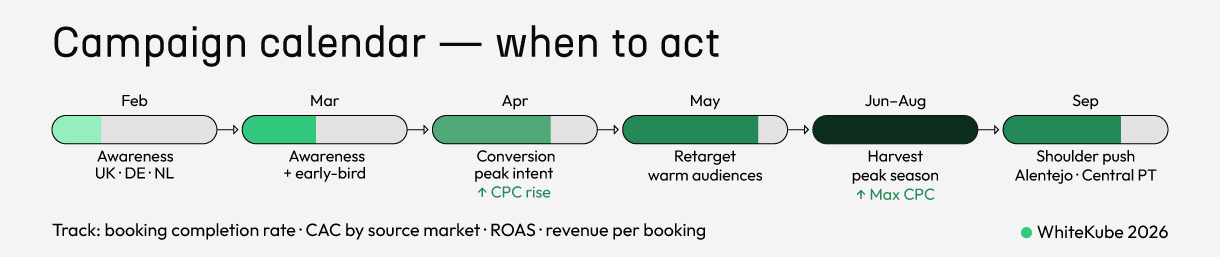
The April-to-June window is when the majority of peak-season bookings are confirmed by international customers who have been planning since February or March. By the time July arrives, much of the most desirable inventory has already been reserved.
Operators who wait until summer to scale their paid search campaigns are paying significantly higher advertising costs to compete for customers who have largely made their decisions. We’re talking about cost-per-click between €2.50 and €5.00 on competitive keywords to capture demand that better-positioned competitors already won at half the cost in April.
This means that the advertising budget should be front-loaded into spring. Investing in targeted campaigns from February onwards allows operators to capture demand before competition and advertising costs reach their peak.
Early-bird campaigns targeting UK, German, and Dutch audiences from February onwards, combined with pre-season SEO content that ranks before the search surge begins, represent the highest-ROI window in the entire acquisition calendar. Waiting for the peak is expensive.
There is another shift worth watching. More European travellers are choosing to travel in September rather than August, driven by milder weather, lower prices, and fewer crowds. As a result, the traditional peak season is beginning to stretch beyond the summer holidays, creating valuable opportunities for operators that can extend their marketing and availability into the shoulder season.
Get your keywords right: location targeting is the way to go, and to know where the bookings actually come from
If there is one lesson from Portugal’s campervan rental market, it’s this: location matters.
Geographically, the Portuguese campervan rental market is concentrated to a degree that should sharpen every operator's targeting strategy.
The vast majority of bookings are concentrated around a handful of destinations. The Algarve alone generates an estimated 35 to 45% of all rentals, while the Lisbon region and its surrounding region (Sintra, Cascais, Setúbal) account for another significant share (60 to 70%). Add Porto and the north of the country into the mix (15 to 20%), and the overwhelming majority of demand is focused around Portugal’s three main tourism gateways.
The location-based keywords that dominate high-intent search reflect this precisely:
- campervan rental Algarve
- campervan hire Faro
- campervan rental Lisbon
- campervan rental Porto
- motorhome rental Portugal
- rent campervan Portugal
- campervan hire Algarve
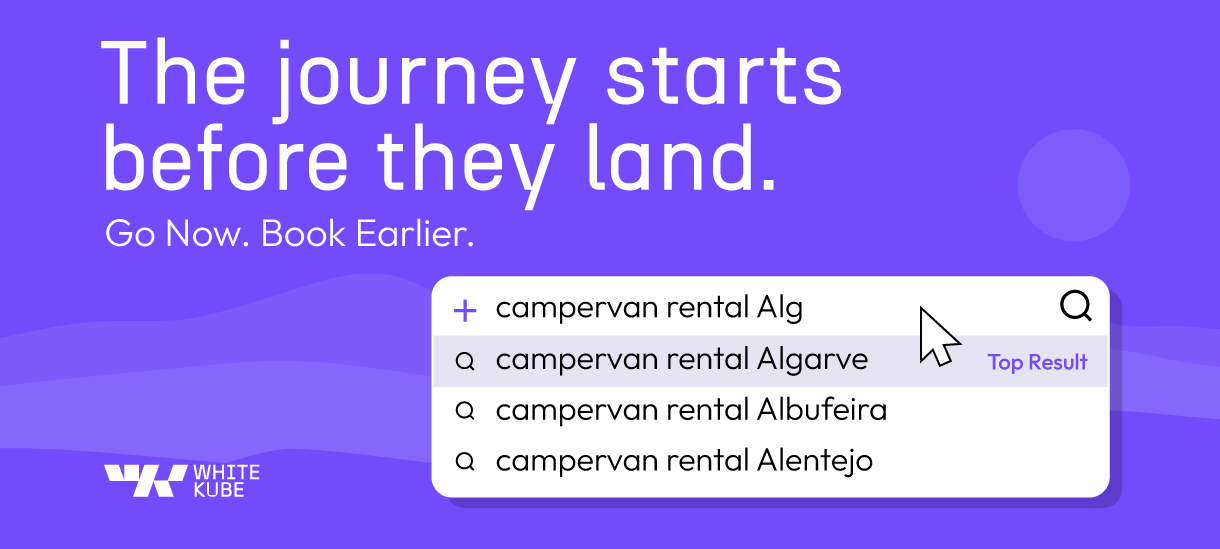
These terms consistently outperform broader, generic keywords. They attract users who already know where they are arriving and are actively looking for a vehicle nearby.
The reason is simple: airports drive demand. Most international travellers land in Faro, Lisbon or Porto and want a straightforward pickup experience. The further a rental location is from the airport, the greater the risk of losing the booking altogether.
For that reason, location-based keywords should sit at the heart of any paid search strategy. Generic searches may generate traffic, but region-specific searches generate customers.
Location-based searches anchored to the specific airport or region where a customer intends to pick up their vehicle are the highest-ROI keywords in any paid or organic search strategy. Terms like "cheap campervan Portugal" and "best campervan Portugal" generate search volume, but the intent signal is weaker, and the conversion quality is noticeably lower.
There is, however, an opportunity beyond the obvious hotspots. Areas such as Central Portugal (accounts for just 5 to 10% of national bookings) and the Alentejo (5 to 8%) remain relatively underdeveloped from a campervan perspective. While search volumes are lower, destinations such as Comporta, the Douro Valley and Serra da Estrela are attracting growing interest from travellers seeking slower, more authentic experiences. For operators willing to position themselves early, these emerging regions could become some of the market's most profitable niches.
Consumer behaviour: what actually wins the booking
Contrary to popular belief, the campervan rental market is not won by whoever offers the lowest price.
For most travellers (especially international visitors and first-time renters), booking a campervan is a considered purchase, where trust comes first and price comes second.
Consumer behaviour research consistently shows that campervan renters, particularly international first-timers, are making a considered, slightly anxious decision, and the factors that resolve that anxiety are not always the ones operators prioritise.
Before comparing rates, customers are checking reviews, ratings and reputation. A business with hundreds of positive reviews will often outperform a cheaper competitor simply because it feels safer and more reliable. When people are spending a significant amount on a holiday, certainty matters.
The booking experience also plays a bigger role than many operators realise. Customers expect a fast, mobile-friendly process with clear pricing and instant confirmation. If booking requires multiple steps, form submissions or waiting for email responses, many will simply move on to a competitor. The benchmark booking completion rate from start to confirmed booking sits between 35 and 55% in high season. If yours is materially below that, the problem is likely in the flow, not the product.
Flexibility has become equally important. Free cancellation up to 30 to 48 hours before pickup is now table stakes for international renters. Travellers want reassurance that plans can change without financial penalties, and operators that fail to offer this often see lower conversion rates as a result.
Perhaps most importantly, transparency sells. Clear pricing, realistic vehicle photography, straightforward insurance terms, visible roadside assistance and easy-to-understand deposit policies all help reduce uncertainty. The less risk customers perceive, the more likely they are to book.
The typical campervan renter in Portugal sits in the 45 to 65 age bracket, followed by 35 to 44-year-olds. These are experienced, confident consumers with disposable income and a clear sense of what they want from the trip and who are not hunting for the cheapest deal available. Their priority is simple: finding an operator they trust to deliver a great holiday without unnecessary complications.
In this market, confidence converts, but price alone rarely does.
The regulatory landscape: 2026 as a turning point
While demand for campervan rentals continues to grow, operators are facing a less favourable cost environment.
Portugal's gradual increase in ISV (vehicle registration tax) on motorhomes, under Lei n.º 20/202, is reshaping fleet economics. The reduced tax rate that once gave operators a significant advantage is being phased out, with 2026 marking the final year before the system moves closer to full passenger-vehicle taxation.
The long-standing reduced rate has been progressively withdrawn: from 30% of the standard table in 2023, through 40% in 2024 and 60% in 2025, to 80% in 2026. In 2027, it reaches 100%, the equivalent of a standard passenger vehicle, with no residual discount.
For businesses planning to expand or refresh their fleet, timing matters, with 2026 being the last year to import with a meaningful fiscal advantage. Importing vehicles from Germany still offers substantial savings thanks to lower purchase prices and a wider selection of stock. However, those advantages are narrowing, and the financial case for importing is likely to become less attractive once the final tax changes take effect.
Regulation is also tightening on the tourism side. Across the Iberian Peninsula, authorities are placing greater scrutiny on overnight parking and wild camping, particularly in popular coastal destinations. As visitor numbers increase, local councils are becoming less tolerant of informal overnight stays, especially in areas already dealing with over-tourism pressures.
For operators, this means customer expectations must be managed carefully. Travellers increasingly need access to authorised campsites, motorhome facilities and clear guidance on where overnight stays are permitted.
The bigger picture remains positive. Demand for motorhome travel across Europe continues to grow, and Portugal remains one of the continent's most desirable road-trip destinations. The challenge for operators is to adapt quickly enough to rising costs, changing regulations and a market that is becoming more professional every year.
Those who plan ahead will be best positioned to benefit from the next phase of growth. But as for the infrastructure to serve that inbound demand, that is still catching up to the scale of the opportunity.
On your marks: what winning looks like
The operators set to outperform over the next two to three years are unlikely to be the ones with the biggest fleets or the deepest advertising budgets. They’ll be the ones who actually understand how the international booking journey works and have built everything (their content, campaigns, booking infrastructure, trust signals) around how that customer actually behaves.
That means meeting customers where they are in their research. English-language content that answers real questions international renters ask during their research phase: route guidance, pickup logistics, insurance explained in plain language, and genuine information about what happens when things go wrong.
It also means playing both sides of the distribution game. In other words, being present on the marketplaces that command early-stage search visibility, while simultaneously investing in a direct booking channel that captures customers who are further down the funnel. Marketplaces matter because they capture early intent and visibility. But your direct booking engine is where profit is protected. Every repeat customer who books direct is commission-free revenue. One builds demand; the other protects margin.
The same clarity applies to measurement. If you’re not tracking website conversion rate, booking completion rate, customer acquisition cost, and return on ad spend, you’re just guessing. And in this market, guessing is expensive.
And most importantly, timing is everything. The operators winning summer 2027 are already planning their next year's spring campaigns. They are building a qualified pipeline in the low-cost, low-competition months before everyone else switches their campaigns on and bids the market up. They’re pre-loading demand months in advance, when costs are lower, and competition is quieter.
That’s the real gap in this market. Demand is growing, search volume is rising, and intent is measurable. The opportunity is not theoretical. The only question is whether your operation is structured to capture it or whether better-prepared competitors are already doing it for you.
How marketers can ride on and make the most of these trends
Understanding the market is one thing. Translating it into actions your marketing team can actually execute is another. Operators now need to be thinking about the campervan rental market, with a different approach, meaning:
- Turn search seasonality into a campaign calendar and/or revenue cycle
- Build geo-targeted paid search campaigns around the three main airports
- Trust engineering like it’s part of the product
- Segment customers properly by customer value
- Use shoulder season as a growth lever
- Track what actually drives bookings
Take the steering wheel… the road is yours
The data is clear: Portugal’s campervan rental market is not a hidden gem anymore, as shown by search volumes.
With high international demand and an infrastructure (digital, physical, and regulatory) maturing fast, it’s now time for the operational and marketing teams to capture it properly.
Portugal's campervan market is accelerating. The question is whether you are going to take the wheel now, or spend another summer watching someone else's bookings fill up first.
The engine is running. The road is clear. Get ready, grab the wheel and go!
Here's some data behind Portugal's campervan boom:
RELATED

.png)


